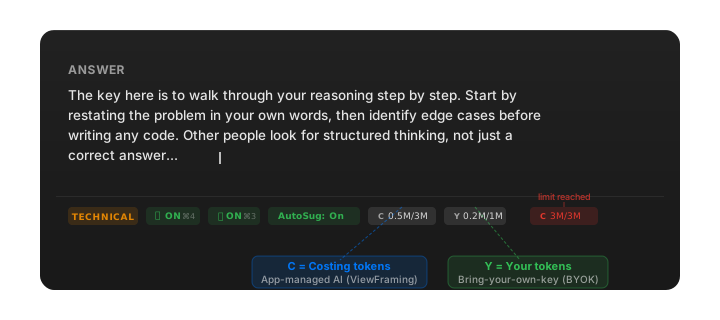
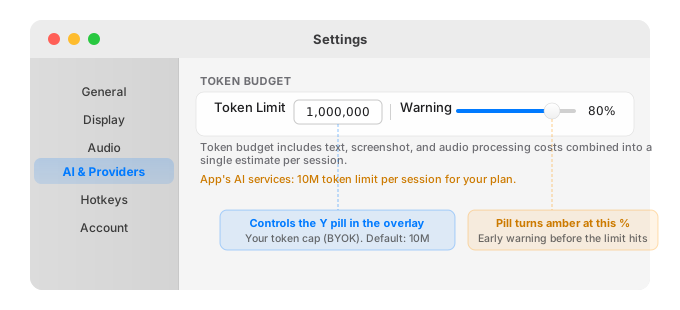
Most AI interview prep is weak for the same reason most rushed prep is weak: the answer has no memory. The model sees a question, guesses a reasonable generic answer, and leaves out the exact things that make a candidate credible - the CV, the job description, the strongest project, the missing ATS keywords, and the handful of topics the interview is actually likely to test.
Context Studio is the preparation layer built to fix that. It brings the profile, CV, cover letter, behavioral stories, job description, topic prep, answer style, ATS checks, and prompt builder into one flow before the live overlay ever starts. The goal is not to generate more text. The goal is to make every answer more anchored: what this role wants, what this candidate has done, and what the overlay should emphasize when pressure makes recall harder.
- CV or resume
- Cover letter
- Behavioral stories
- Role, level, and industry
- Company and role
- Required skills
- Responsibilities
- Likely question areas
- ATS CV check
- JD match score
- Tailored CV draft
- Cover letter and intro
- Topic cues
- Profile examples
- Answer style
- Prompt builder output
Here is a concrete example. Maya is applying for a Senior Backend Engineer role at a fintech company called FinPay. Her CV says she has five years of backend experience, strong PostgreSQL work, API ownership, a production migration, and one measurable win: a database project that reduced latency by 40%. The job description asks for payment reliability, PostgreSQL, Kafka, AWS, observability, and system design.
| Input | Raw detail | Prepared signal |
|---|---|---|
| Profile | Backend engineer, APIs, PostgreSQL, cloud infrastructure, production debugging. | Use the latency project and migration story whenever backend reliability comes up. |
| Job description | Payment systems, Kafka, AWS, observability, high-scale backend services. | Questions will likely probe idempotency, retries, event-driven workflows, and monitoring. |
| Gap | CV does not clearly mention Kafka, observability, or payment reliability. | Tailor the CV only where truthful, and prep answers that connect existing backend work to those areas. |
That analysis drives the application toolkit. A normal ATS check asks whether the CV is readable by applicant tracking systems. A JD-specific ATS check asks the more useful question: does this CV match this role? In Maya's case, the original CV is readable but under-targeted.
Readable structure, strong PostgreSQL result, but weak role alignment for Kafka, AWS, observability, and payment reliability.
Clearer backend reliability summary, stronger keyword balance, and bullets rewritten around production impact.
| Before | After |
|---|---|
| Worked on backend services and improved performance. | Improved backend API performance by optimizing PostgreSQL queries and service-level caching, reducing average request latency by 40% across high-traffic workflows. |
| Helped with migration work for internal services. | Led a safe backend migration plan with rollout checkpoints, monitoring, and fallback steps to protect production reliability during the transition. |
The same profile and job context can generate a tailored cover letter, a short spoken introduction, and a prompt bundle for another AI subscription. The important boundary is that application drafts stay tied to this session. The tailored CV and cover letter are not injected into live coaching prompts. The short introduction can be used live because it is directly useful for questions like "tell me about yourself."
CV context changes a different layer of the answer. Topic prep tells the model which angles to cover. CV context tells it which evidence belongs to this candidate. That is why the same "tell me about yourself" question sounds very different once the profile is loaded.
The biggest difference shows up in the overlay. Without topic prep, the assistant can still answer the question, but it tends to answer like a smart generalist. With topic prep, the same question gets routed through the angles you already prepared: subtopics, coverage cues, prompt addendum, and the candidate stories that make the answer real.
AI style sits on top of that context. A useful style instruction is not "sound smart." It is more operational: answer like a senior backend engineer, lead with the concise decision, then explain the trade-off, and use profile examples when they fit. With that instruction, the overlay stops sounding like a lecture and starts sounding like the candidate on a good day.
Copy Prompt Builder
The prompt builder copies a Markdown bundle the candidate can paste into another AI subscription, improve there, and bring back as a stronger custom instruction.
# Goal
Prepare me for a Senior Backend Engineer interview at FinPay.

# Candidate Profile
5 years backend engineering. APIs, PostgreSQL, cloud infrastructure, production debugging.

# Job Description Signals
Payment reliability, Kafka, AWS, observability, system design, high-scale backend services.

# Strongest Evidence
- Reduced PostgreSQL query latency by 40%
- Led a safe backend migration with no major downtime
- Built APIs used by multiple product teams

# Answer Style
Confident, concise, practical. Lead with the decision, explain trade-offs, then use one real example.

# Task
Create topic-specific answer guidance and practice prompts that use my profile and the job description.
This is the real value of the toolkit. It does not replace preparation. It makes preparation portable. The profile improves the application drafts. The job description sharpens the ATS score. Topic prep tells the overlay which angles matter. CV context gives the answer proof. Prompt style makes the delivery sound like the candidate instead of a generic model. When those pieces are connected, the generated answer is no longer just "correct." It is specific, defensible, and easier to say out loud.